Ancient Egyptian trips civilization left behind pyramids, temples, and tombs — but its most enduring legacy may be ancient egyptian gods family tree that explained the universe itself.
Long before genealogists traced human bloodlines, Egyptian priests were mapping the relationships between creator gods, sibling rivals, and avenging sons to explain how the world began, why the Nile flooded every year, and what happened to a person after death.
Understanding this genealogy means more than memorising names. The Egyptian pantheon was a living framework used to justify kingship, explain natural cycles, and give meaning to death and rebirth.
This guide traces the core lineage — from the primordial waters of Nun through the dramatic Osirian myth — and introduces the wider cast of gods and goddesses who shaped Egyptian religion for more than three thousand years.
Each figure and story below has enough depth to deserve its own dedicated article, so treat this as your map of the territory before going deeper into any single branch.
How the Family Tree Changed Over Three Thousand Years
Egyptian religion was never static. Over centuries, gods merged, rose, and fell from prominence as political power shifted between cities. Ra combined with Amun; Ptah’s creative role was absorbed into later cosmologies; and briefly, under the pharaoh Akhenaten, the sun disc Aten was declared the only god in Egyptian history’s most dramatic religious upheaval — a change that reversed almost entirely after his death.
This is why Egyptologists describe the family tree of egyptian god family tree as a composite rather than a single fixed genealogy. What survives today is a best-effort reconstruction drawn from temple inscriptions, tomb paintings, and religious texts spanning more than three millennia of Egyptian civilization.
Why the Egyptian Pantheon Is Structured Around Family
Unlike many modern religious systems, Egyptian myth organised its gods almost entirely through kinship: parents, children, siblings, and spouses. This wasn’t incidental. Pharaohs justified their right to rule by tracing descent from Horus and, by extension, from Ra himself.
Priests in different cities — Heliopolis, Memphis, Thebes — each promoted their own local creator god as the head of the family tree, which is why you’ll sometimes see Atum, Ra, Ptah, or Amun each described as “the first god” depending on the source.
That regional variation is important context: the Egyptian gods family tree isn’t a single, fixed chart handed down unchanged for three millennia.
It’s closer to several overlapping family trees that Egyptologists have combined into one workable structure — most commonly built around the Heliopolitan Ennead, the nine-god family that became the backbone of Egyptian creation myth.
Want to learn more about Egyptian Gods? Take a look at our Luxor Trips at best prices.
The Creation Myth: How the First Gods Emerged
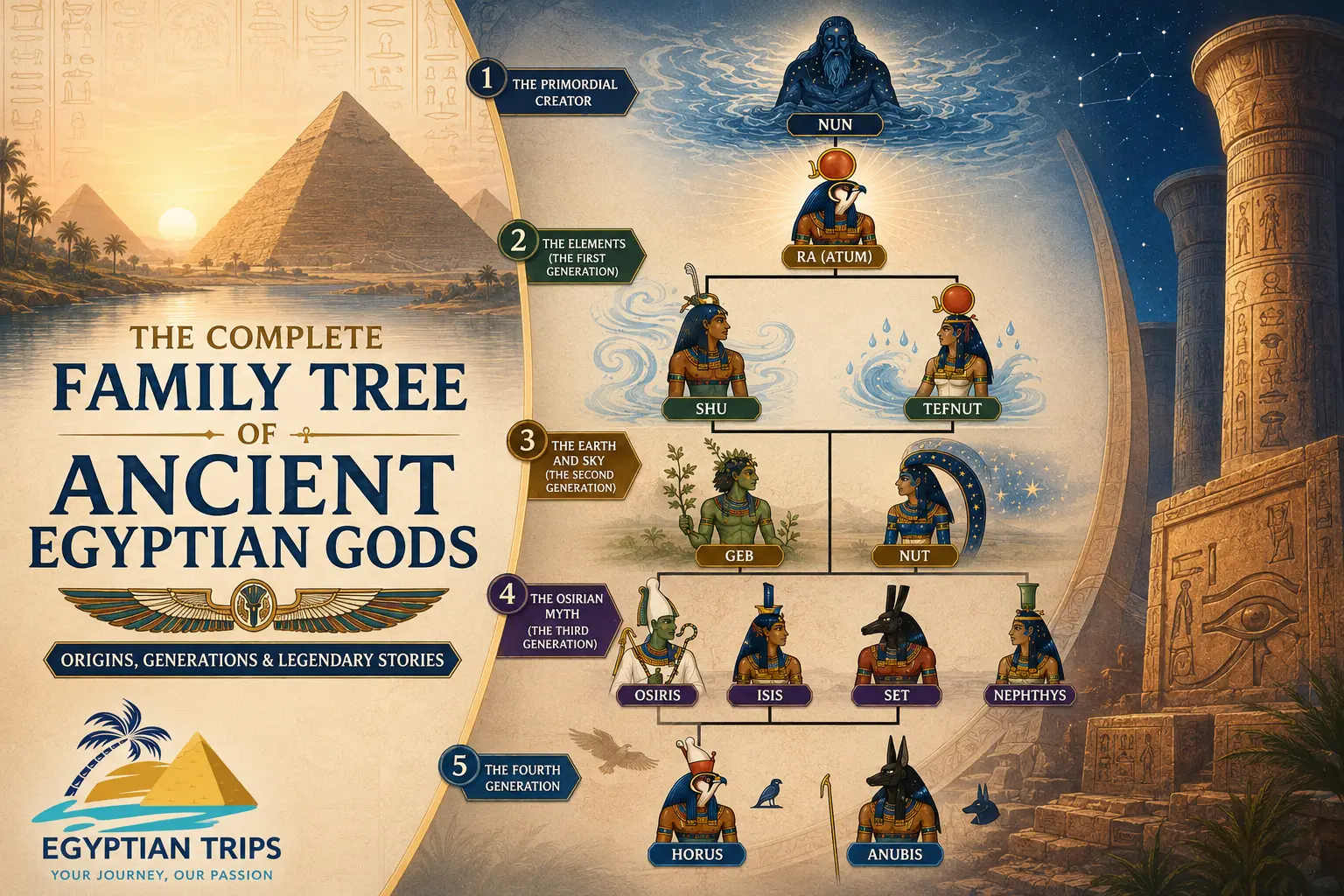
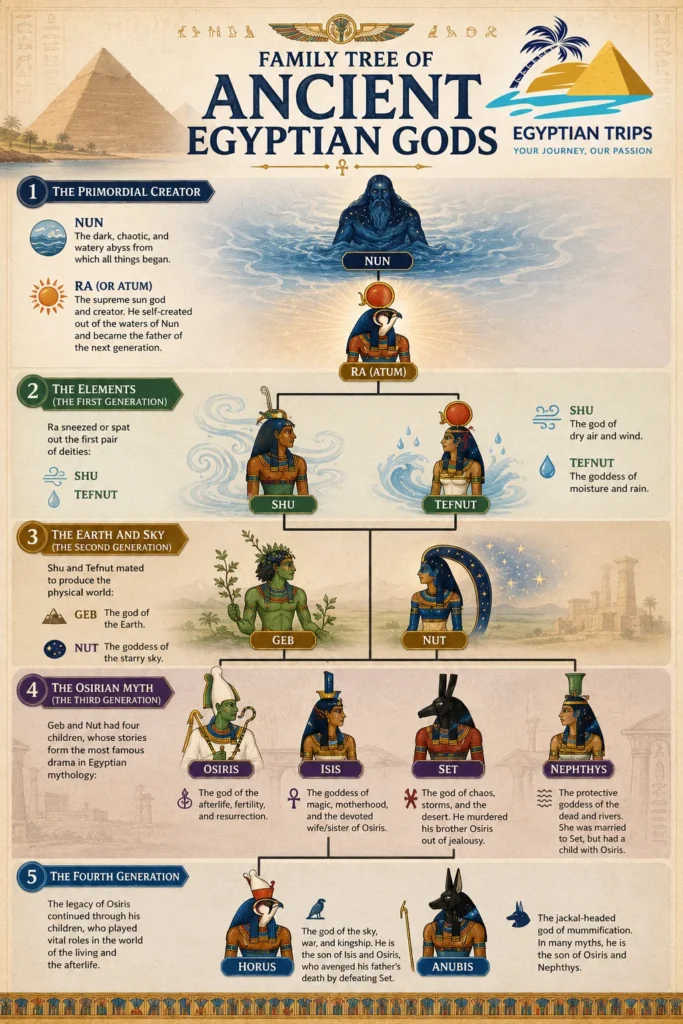
Every family tree needs a starting point, and in Egyptian mythology that point is Nun — not a god in the usual sense, but the dark, boundless, watery abyss that existed before creation. From these waters, the first true god rose by his own will.
Nun and Atum: The Self-Created God
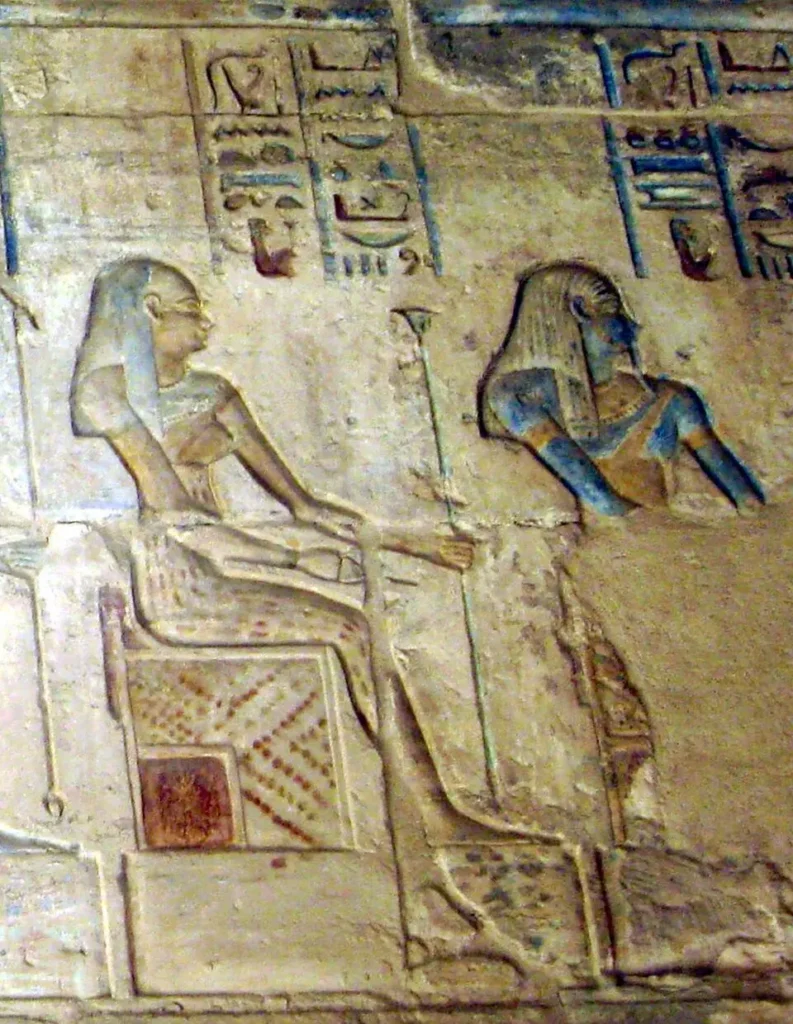
Atum (later merged with Ra as the more widely known sun god) emerged from Nun through pure force of will, without parents or predecessors.
According to the Heliopolitan version of the Egyptian creation myth, Atum created the next generation of gods alone — by spitting or sneezing them into existence, an origin story that sounds strange today but reflected a belief that creation itself was an act of divine self-sufficiency.
- Nun: the primordial waters; represents chaos before order existed.
- Atum/Ra: the self-created creator god and sun deity; father of the first generation.
Shu and Tefnut: The First Divine Pair
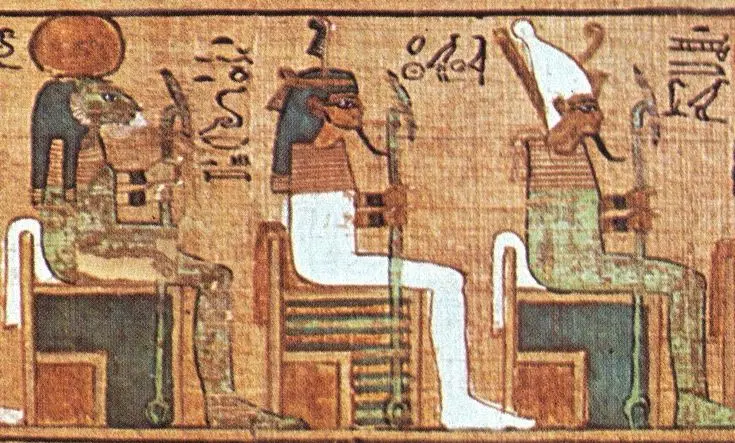
Atum’s first children were Shu, god of air, and Tefnut, goddess of moisture — twins born from breath rather than birth. Their separation from their father and eventual return introduced one of Egyptian mythology’s recurring themes: loss followed by reunion, a motif that echoes throughout the rest of the family tree.
Know More about: Egyptian Clothing
Geb and Nut: Earth and Sky
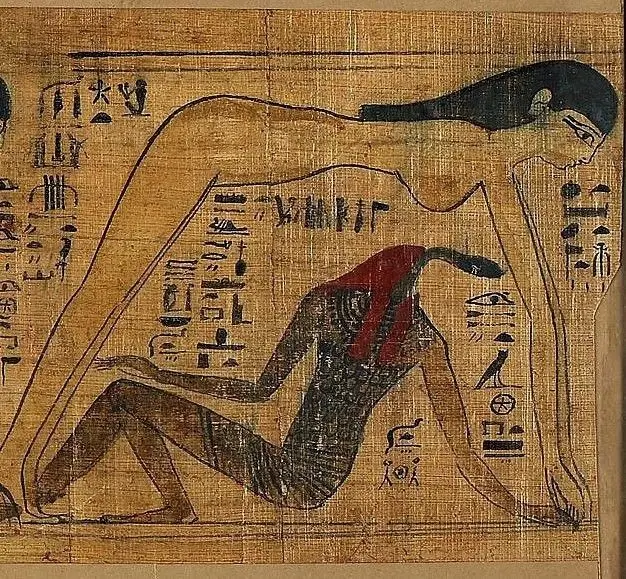
Shu and Tefnut, in turn, produced Geb, god of the earth, and Nut, goddess of the sky. Their myth is one of the most visually iconic in Egyptian religion: the lovers were forcibly separated by their own father, Shu, who held Nut aloft while Geb remained below, physically creating the space between earth and sky that appears in countless tomb paintings.
Geb and Nut Family Tree
Nut is the ancient Egyptian goddess of the sky, while Geb is the god of the earth. In ancient Egyptian mythology, Geb and Nut are described as siblings as well as husband and wife.
Together, they had five children: Osiris, Isis, Set (Seth), Nephthys, and Horus the Elder. These deities became some of the most important figures in ancient Egyptian mythology and played central roles in the stories of the gods and the afterlife.
The Osirian Myth: Egypt’s Most Famous Divine Family
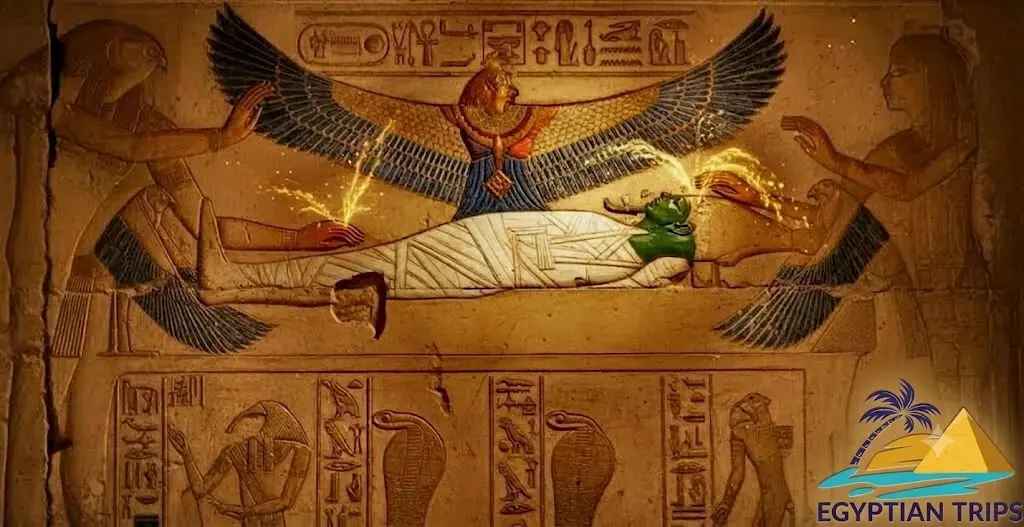
Geb and Nut had four children — Osiris, Isis, Set, and Nephthys — and their story is the emotional centre of the entire Egyptian pantheon. It’s a family drama built on betrayal, devotion, and restoration, and it shaped Egyptian beliefs about kingship and the afterlife more than any other myth.
Osiris, Isis, Set, and Nephthys
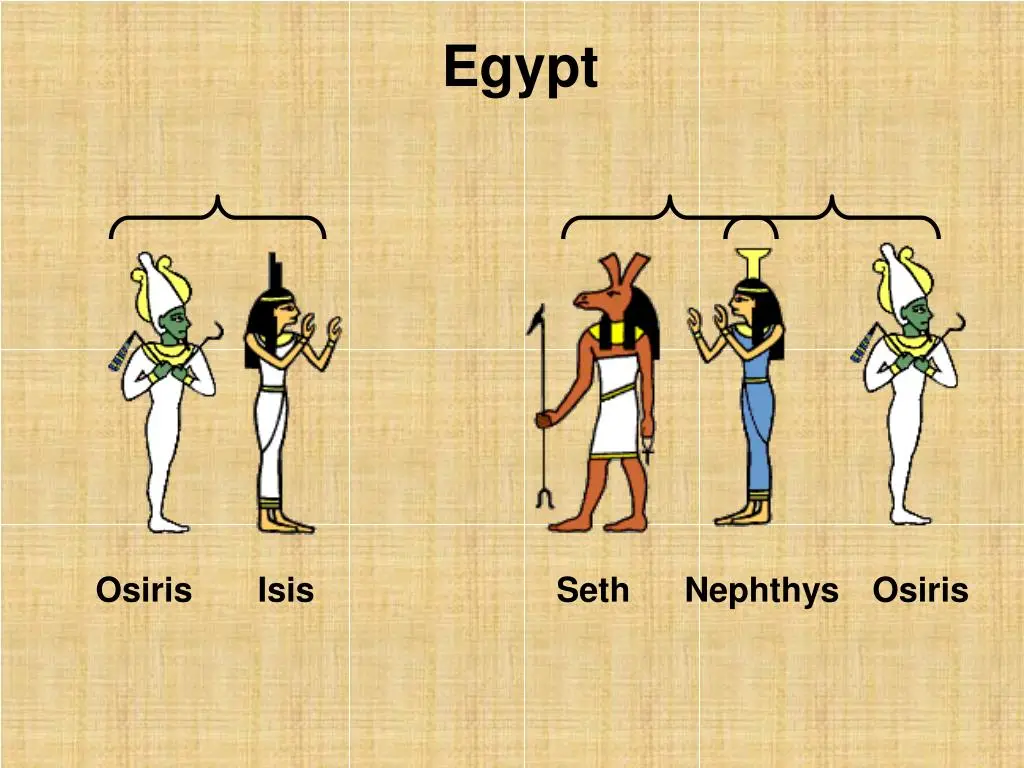
Osiris, the eldest, became king of the gods and ruler of fertility and order. His sister-wife Isis was renowned for magic and devotion. Their brother Set, god of chaos, storms, and the desert, grew jealous of Osiris’s throne and murdered him, scattering his body across Egypt.
Nephthys, Set’s wife, sided with her sister Isis in the aftermath — a quiet but crucial act of loyalty within the myth.
Isis famously gathered Osiris’s remains and used her magic to briefly resurrect him, conceiving their son Horus before Osiris passed permanently into the underworld as ruler of the afterlife.
Horus and the Legacy of Divine Kingship
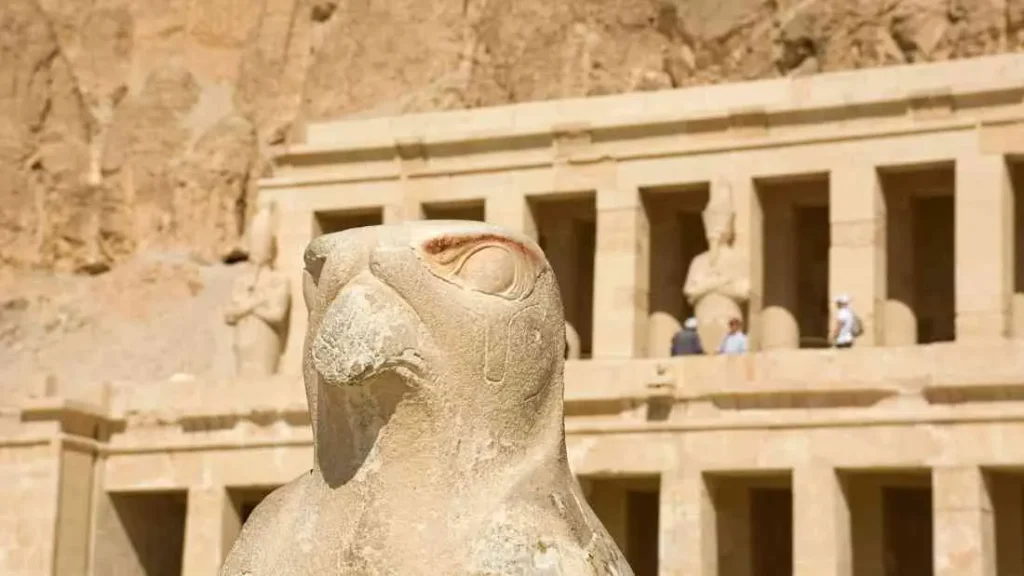
Horus, born of Isis and Osiris, grew up in hiding before confronting his uncle Set to reclaim the throne. His eventual victory became the mythological basis for Egyptian kingship: every pharaoh was considered a living incarnation of Horus, which is why falcon imagery appears so consistently in royal iconography.
Anubis: Guardian Born of Secrecy
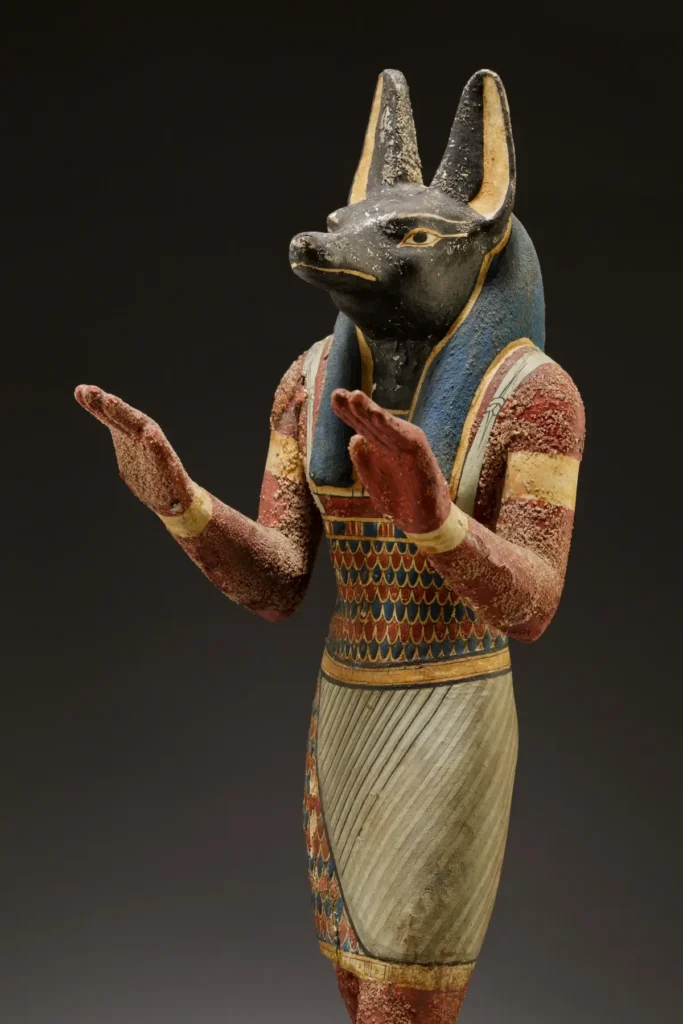
Anubis, the jackal-headed god of mummification, is most often described as the son of Osiris and Nephthys — a child born from a quiet affair kept hidden from Set. Anubis later became one of the most recognisable figures in Egyptian religion, guiding souls through the embalming process and, in many traditions, weighing hearts against the feather of Ma’at.
Want to learn more about Egyptian Gods? Take a look at our Aswan Trips at best prices.
Beyond the Ennead: Other Major Branches of the Pantheon
The Heliopolitan Ennead forms the backbone of the family tree, but the wider Egyptian pantheon includes dozens of additional gods tied to specific cities, functions, and later political shifts.
The Theban Triad: Amun, Mut, and Khonsu
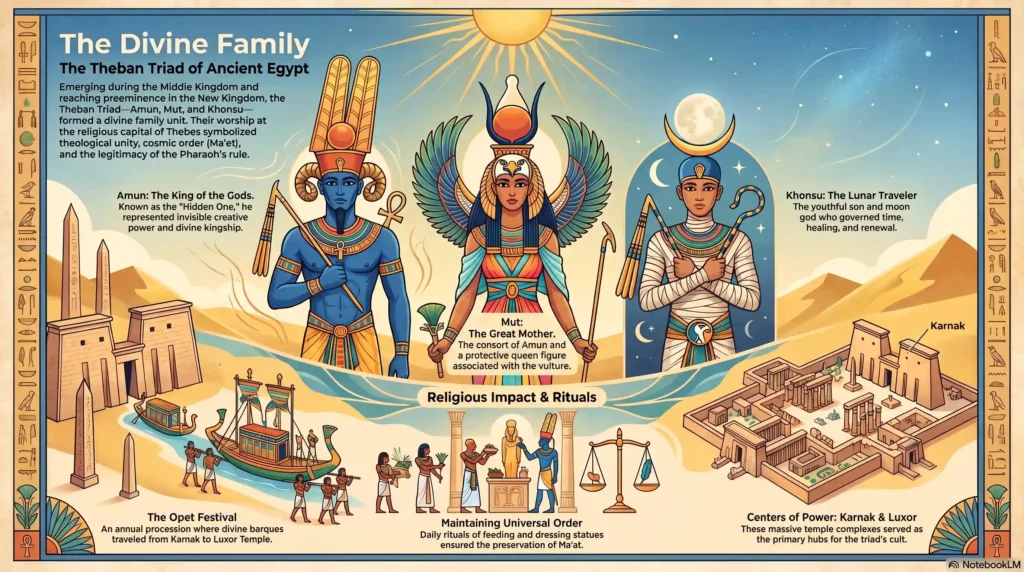
As Thebes grew into Egypt’s political capital, its patron god Amun rose in importance, eventually merging with Ra to become Amun-Ra, king of the gods. His consort Mut was worshipped as mother of the gods, and their son Khonsu, associated with the moon and time, completed the Theban family unit.
The Memphite Tradition: Ptah and His Circle
In Memphis, priests credited Ptah — a god of craftsmanship and creation — with speaking the other gods into existence. Ptah was linked to Sekhmet, the fierce lioness goddess of war and healing, and Nefertem, a god of beauty and perfume born from a lotus flower.
Local and Regional Deities
Dozens of other gods entered the pantheon through local worship or foreign trade — Khnum, the ram-headed god credited with shaping humanity on a potter’s wheel; Wadjet and Nekhbet, protective goddesses of Lower and Upper Egypt respectively; and imported deities like Qadesh and Reshep, absorbed from Canaanite religion.
Egyptian religion was rarely exclusive — new gods were usually added to the family tree egyptian gods rather than replacing existing ones.
Read our complete guide to Egypt’s regional gods and how local pantheons merged into the national religion.
Goddesses of the Egyptian Pantheon
Goddesses held some of the most significant roles in Egyptian myth, representing everything from motherhood to divine justice.
- Isis — magic, motherhood, and devotion; central figure of the Osirian myth.
- Hathor — love, joy, music, and the divine mother of the pharaoh.
- Sekhmet — war, healing, and righteous fury; sent by Ra to punish humanity.
- Bastet — protection, home, and motherhood, often depicted as a cat.
- Ma’at — truth, balance, and cosmic order; weighs the hearts of the dead.
- Neith — creation, weaving, and war; an early and independent creator goddess.
Know More: How Are Hieroglyphics Different From Any Other Writing System?
Egyptian Gods vs Greek Gods: Comparing Two Ancient Pantheons
Because Greek mythology is often the more familiar reference point, comparing the Egyptian pantheon to Greek gods can help clarify each deity’s role.
The Greeks themselves drew these connections during their rule of Egypt under the Ptolemaic dynasty, blending Egyptian and Greek mythology into hybrid figures like Hermanubis, a fusion of Anubis and Hermes.
| Domain | Egyptian God/Goddess | Greek Equivalent |
| King of the gods / sky | Amun-Ra | Zeus |
| Ruler of the underworld | Osiris | Hades |
| Love, beauty, and fertility | Hathor | Aphrodite |
| War, chaos, and conflict | Set | Ares |
| Wisdom, writing, and knowledge | Thoth | Hermes |
| Motherhood and magic | Isis | Demeter (partial parallel) |
| The sun | Ra | Helios |
These comparisons are useful shorthand, but they’re not exact. Egyptian gods carried distinct regional histories and religious functions that don’t map perfectly onto their Greek counterparts — Osiris, for instance, combines aspects of kingship, fertility, and the afterlife that Hades alone doesn’t capture.
Explore Egypt With EgyptianTrips — Your Trusted Guide to Ancient Wonders
At EgyptianTrips, we don’t just show you Egypt — we bring its history to life. As a leading tourism company based in Egypt, we specialise in fully guided tours to every major archaeological site in the country, from the pyramids of Giza to the temples of Luxor and the timeless beauty of Aswan.
Whatever kind of trip you’re dreaming of, we’ve got you covered:
- Multi-day tours to Egypt — comprehensive itineraries covering Egypt’s most iconic historical sites
- Day trips in Egypt — perfect for exploring a single destination without the commitment of a longer journey
- Family trips to Egypt — safe, comfortable, and thoughtfully paced for travellers of all ages
- Honeymoon packages to Egypt — romantic, private experiences designed for couples celebrating a new chapter.
Know More About: How Much Is a Trip to Egypt?
Looking to combine history with relaxation? Our Nile cruise trips pair unforgettable sightseeing with five-star onboard service, letting you drift past centuries of history in complete comfort.
At EgyptianTrips, quality never comes with a hidden cost. We offer some of the most competitive prices in the industry, paired with expert local guides, seamless logistics, and a genuine passion for showing you the Egypt we love.
Ready to start your journey? [Explore our tours] and let EgyptianTrips turn your trip into the adventure of a lifetime.
Final Thoughts
The family tree of the egyptian gods is far more than a genealogical chart — it’s the framework ancient Egyptians used to explain existence itself, from the flooding of the Nile to the legitimacy of their kings.
Whether you’re drawn to the tragedy of Osiris and Isis, the triumph of Horus, or the sheer scale of the wider Egyptian pantheon, each branch of this family tree opens into a deeper story worth exploring on its own.
Know More About: Best Nile River Cruises in Egypt
Frequently Asked Questions
What is the correct family tree of the ancient Egyptian gods?
The most widely cited version follows the Heliopolitan Ennead: Nun precedes Atum/Ra, who fathers Shu and Tefnut, who in turn produce Geb and Nut, whose children are Osiris, Isis, Set, and Nephthys. Horus and Anubis represent the following generation.
Who is the oldest god in the Egyptian pantheon?
Nun is generally considered the oldest, representing the primordial waters that existed before creation. Atum (or Ra) is typically described as the first true god to emerge and create.
How does Anubis fit into the family tree?
Anubis Family Tree is one of the most well-known ancient Egyptian gods associated with death, mummification, and the afterlife. He is most commonly considered the son of Osiris, the god of the afterlife, and Nephthys, the goddess associated with mourning and protection of the dead.
Are the Egyptian gods related to Greek gods?
Not by lineage, but many Egyptian gods have functional parallels in Greek mythology, and some were directly merged during the Ptolemaic period, such as Anubis and Hermes forming Hermanubis.
Why do different sources show different Egyptian family trees?
Ancient Egypt was made up of multiple regional religious centres — Heliopolis, Memphis, Thebes, and others — each with its own version of the creation myth and its own preferred lineage for the chief creator god.