
The Grand Egyptian Museum, widely known simply as GEM, is the largest archaeological museum in the world dedicated to a single civilisation, and after two decades of construction, it’s now fully open on the Giza Plateau, just a couple of kilometres from the Pyramids themselves.
If you’re planning an Egypt itinerary in 2026, this is no longer an optional add-on; it’s arguably become the single most important stop in Cairo, housing more than 100,000 artefacts spanning prehistory through to the Greco-Roman era, including the complete Tutankhamun collection shown together for the first time since Howard Carter’s 1922 discovery.
This guide from Egyptiantrips covers everything worth knowing before you go: the museum’s architecture and history, current GEM ticket prices and opening hours, what’s actually inside the galleries, and practical tips, from photography rules to accessibility, that’ll help you plan a visit that matches how much time and interest you actually have.
What Is the Grand Egyptian Museum?
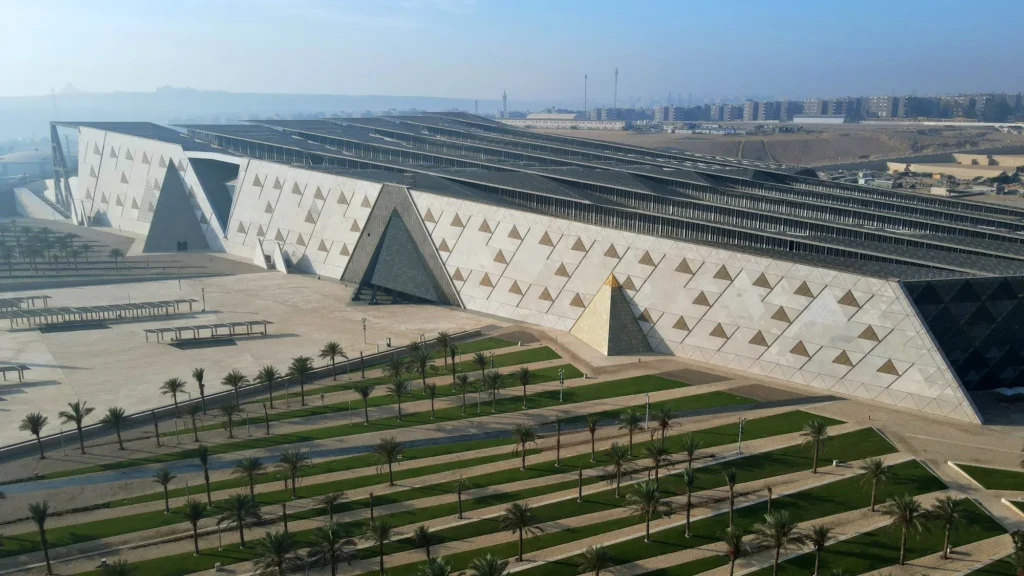
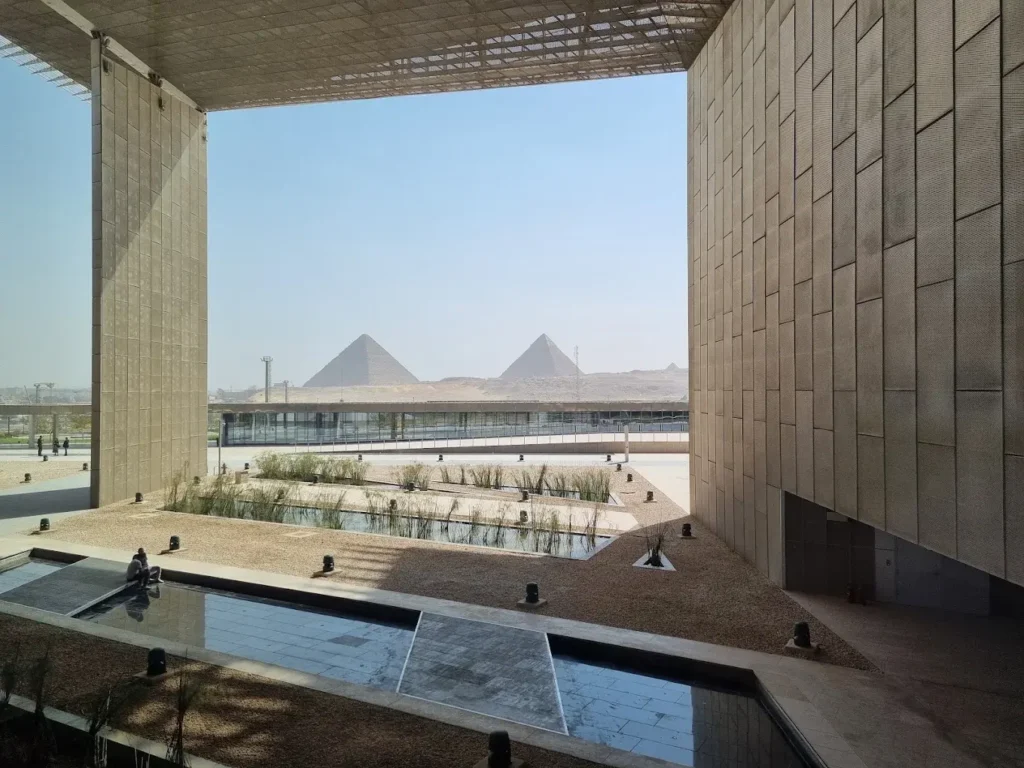
The Grand Egyptian Museum sits on the edge of the Giza Plateau, its roofline deliberately aligned with the level of the pyramids before the building descends toward the Nile Valley, where the main visitor entrance is located.
The complex covers roughly 500,000 square metres in total, around 92,000 square metres of that dedicated purely to museum and gallery space, with the remainder split between gardens, commercial areas, and public plazas.
Twelve main galleries opened to the public in October 2024, with the Tutankhamun Galleries and the separate Khufu’s Boats Museum completing the full opening on November 4, 2025.
What sets the GEM apart from other major world museums isn’t just its scale, it’s the singular focus.
Everything inside is dedicated to Ancient Egypt specifically, covering the Pharaonic period from roughly 3050 BCE through to 394 CE. Royal mummies aren’t part of the collection here; they remain respectfully displayed in the Mummies Hall of the National Museum of Egyptian Civilization elsewhere in Cairo, a site worth combining with a GEM visit if mummies are high on your list.
Architecture and Exterior Design
The building itself was designed by Heneghan Peng Architects, an Irish firm that won Egypt’s Ministry of Culture design competition in 2003, beating out 1,557 competing entries from 82 countries.
The result is a striking alabaster-and-glass facade decorated with triangular motifs of varying size and colour, a deliberate architectural nod to the pyramids themselves. Even the paving stones surrounding the shallow reflecting pools on the entrance esplanade are cut into pyramidal shapes.
Outside the main entrance, visitors pass beneath the Hanging Obelisk of Ramses II, suspended dramatically above the approach, the first “hanging obelisk” of its kind, positioned so guests can walk directly underneath and see the carved inscriptions from below.
Once through the entrance, the atrium opens onto the museum’s most immediately recognisable feature: the colossal 3,200-year-old, 82-tonne statue of Ramses II, which has stood in the atrium since 2018, welcoming visitors years before the rest of the museum was ready to join it.
History and Construction Timeline
Construction on the GEM began in 2005, but the project was far from a smooth, uninterrupted build. Work halted for roughly three years following the 2011 Arab Spring, as political instability and a sharp drop in tourism income slowed government funding.
From 2014 onward, construction resumed with substantial financial and technical support from Japan, eventually leading to a phased opening: the 12 main galleries in October 2024, followed by the Tutankhamun Galleries and Khufu’s Boats Museum in November 2025, more than two decades after ground was first broken.
Grand Egyptian Museum Tickets: Prices and Booking
GEM ticket prices are tiered by nationality, age, and visitor category. As of 2026, here’s what foreign visitors can expect to pay:
| Ticket Type | Price (EGP) | Price (approx. USD) |
| Foreign Adult | 1,450 EGP | ~$30 |
| Foreign Student (13–25, valid ID) / Child (6–12) | 730 EGP | ~$15 |
| Child Under 6 | Free | Free |
| Egyptian National (Adult) | 200 EGP | ~$4 |
Note that: For groups of more than 5 visitors, each additional visitor will be provided with a headset at an extra cost of 100 EGP (approximately $2) per person.
Egypt’s Ministry of Tourism and Antiquities has confirmed a further price adjustment taking effect November 1, 2026, raising the foreign adult rate by roughly $5 and the Egyptian resident rate by about 20 EGP, worth factoring in if you’re booking for late 2026 or beyond.
Tickets can only be purchased online through the museum’s official ticketing portal; on-site ticket sales have been suspended, so arriving without a booking isn’t a safe bet, especially during the busy October-to-April season. Be wary of third-party sellers outside the museum grounds, the official portal is the only authorised source for GEM admission.
Book your Ticket Here
Egypt GEM Opening Hours
The museum galleries are generally open daily from 9:00 AM to 6:00 PM, with last tickets typically sold around two hours before closing.
On Wednesdays and Saturdays, gallery hours extend to 9:00 PM, and the wider museum complex, including the shops and gardens, stays open even later on those two evenings.
Hours can shift around Ramadan and public holidays, so it’s worth confirming the current schedule on the official website close to your visit date rather than relying on hours quoted in older articles.
Inside the Grand Egyptian Museum: Layout and Galleries
One of the more genuinely impressive things about the GEM is how well-organised the interior experience is, especially for a museum of this scale.
The galleries are arranged around three thematic pillars, Society, Kingship, and Beliefs, each divided into four chronological groupings spanning from the Prehistoric and Early Dynastic periods through to the Greco-Roman era.
Every gallery is clearly numbered, with a posted floor plan showing exactly where you are, which makes it genuinely easy to plan a visit around a specific era, a specific theme, or just wander freely.
Exhibit labelling follows the same thoughtful approach: information panels are printed in English, Arabic, and Braille, angled to avoid glare from overhead lighting, and kept deliberately brief.
Colour-coded panels give a broader overview of a display case’s general subject, while grey or white panels provide detail on specific artefacts inside it.
If you like to plan ahead, many visitors find it worth reviewing the gallery floor plan, available through the museum’s official visitor resources, before arriving, so you’re not deciding where to go on the fly inside a 92,000-square-metre exhibition space.
Must-See Exhibits and Antiquities
With more than 100,000 artefacts spread across a complex this size, it’s worth knowing which exhibits are worth prioritising if your time is limited.
King Tutankhamun Galleries
Mask of Tutankhamun
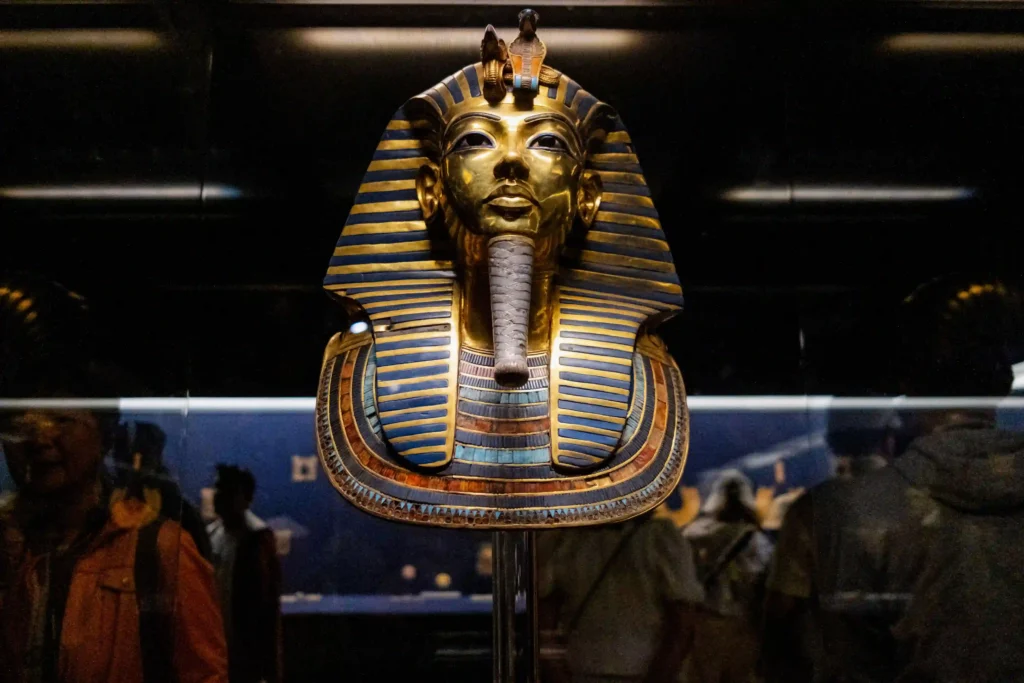
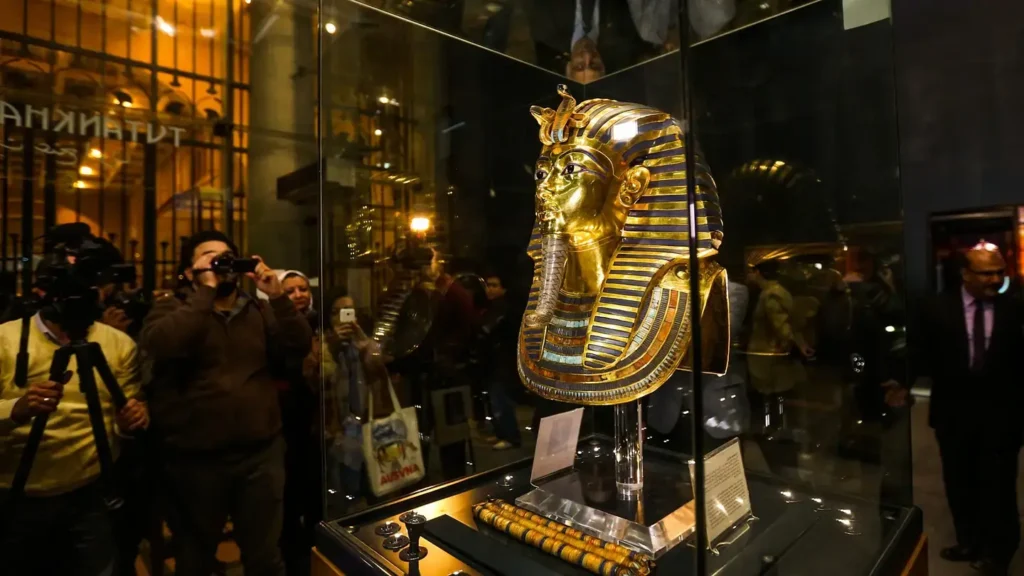
Accessed from gallery 7, the Tutankhamun Galleries are the undisputed centrepiece of the GEM, the first time the boy king’s complete collection of more than 5,000 objects has ever been displayed together in one place.
The galleries are organised into five thematic sections: Discovery, covering the excavation of his tomb; Lifestyle, his personal possessions; Rebirth, exploring afterlife beliefs; Funeral, the preservation of his body and burial treasures; and Identity, which includes a striking facial reconstruction video based on his skull.
The room housing the golden funerary mask and golden sarcophagi is, understandably, the single most visited spot in the entire museum, arrive early if you want to see it without a crowd.
The Colossal Statue of Ramses II+
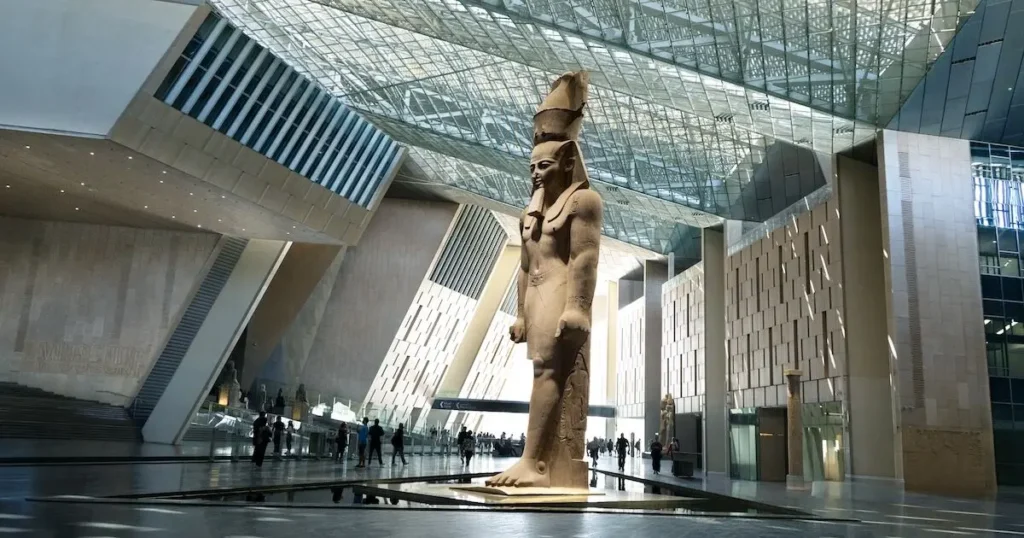
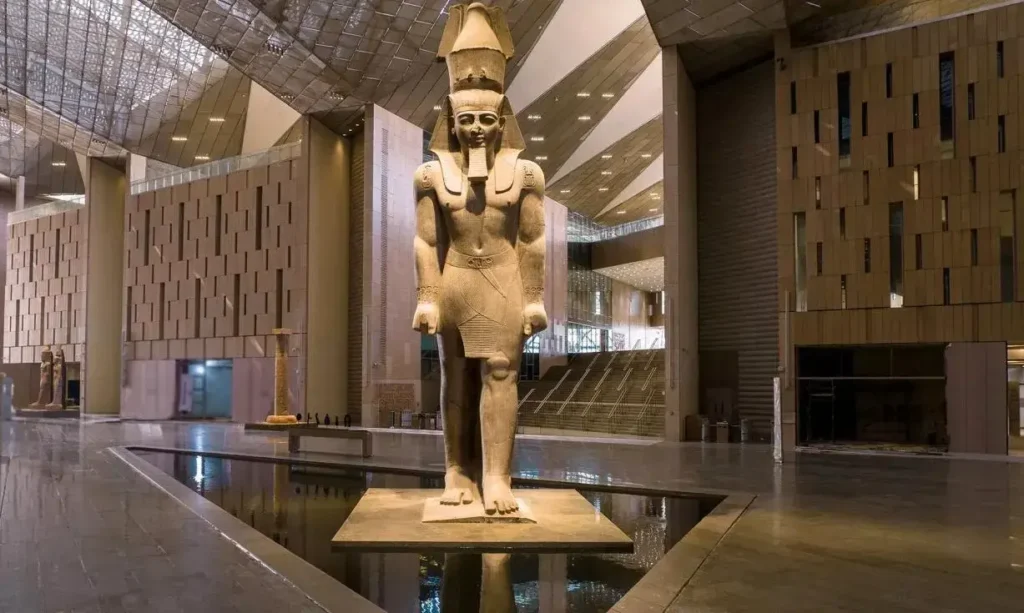
Standing in the Grand Hall, this is the largest statue in the museum and one of its most photographed pieces, a fitting welcome given that Ramses II is remembered as one of ancient Egypt’s most powerful pharaohs.
Khufu’s Solar Boats
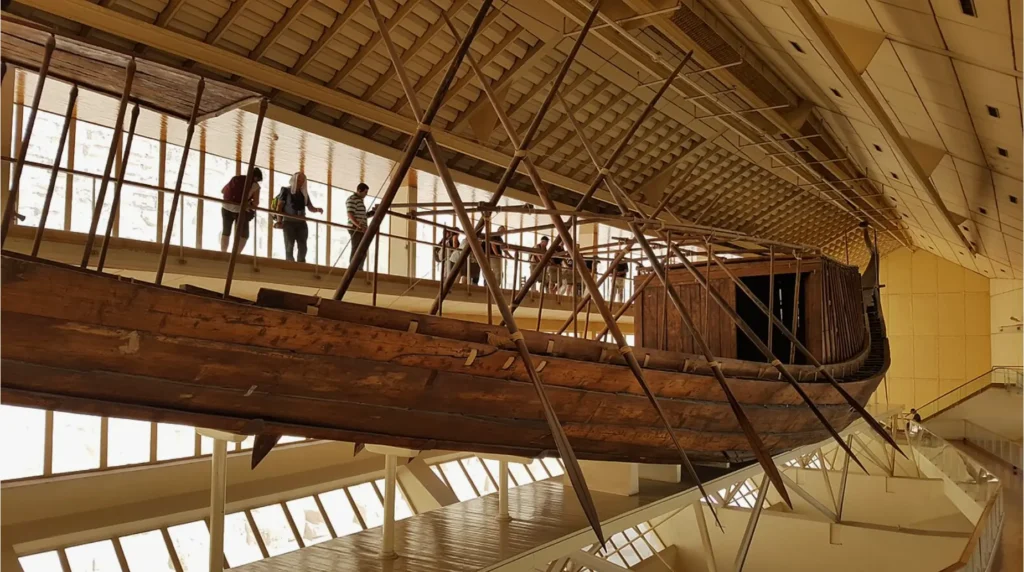
Housed in a separate building at the back of the main museum, reachable via a plaza with its own fountain, this exhibit contains the two oldest wooden boats in the world.
The first, a 42.32-metre vessel discovered dismantled and buried near the Great Pyramid in 1954, took roughly a decade to reassemble before moving to its current home in 2021.
A second boat, found at the same site, is being reconstructed on-site in full view of visitors, a rare chance to watch active archaeological restoration happen in real time.
The Grand Staircase
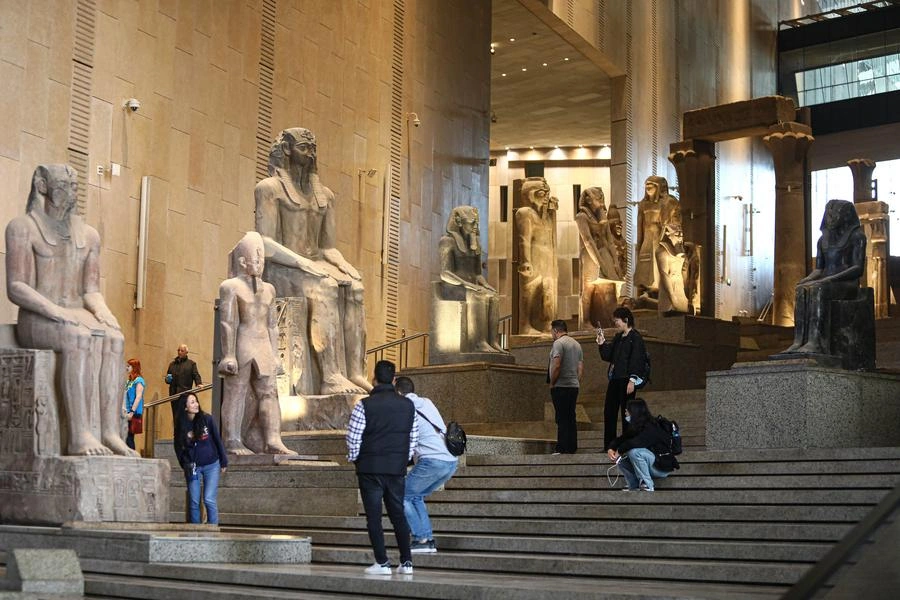
The Grand Staircase is one of the GEM’s signature architectural moments: a multi-section staircase lined with more than 70 large-scale statues and monuments, tracing a visual timeline of ancient Egyptian dynasties as you climb.
An escalator runs alongside for anyone who’d rather take it slow and actually look at the statues rather than power up the steps. At the top, you’re rewarded with a genuinely spectacular view over the Giza Plateau.
One practical tip worth knowing
the Grand Hall (home to the Ramses II statue) and the Grand Staircase both stay open roughly an hour later than the main galleries, so it’s worth saving them for the end of your visit rather than rushing them early, in case time runs short elsewhere.
Ready to Explore Grand Egyptian Museum?
Don’t just read about the GEM and ancient Egypt — come experience it for yourself.
Free ConsultationFree Cancellation · Expert guides · Best-prices
Planning Your Visit: Practical Tips
- Plan Ahead: This is a massive site. Allow for at least a full day to truly appreciate the breadth of the collections.
- Pair with Giza: Because of its proximity to the Great Pyramids, it is the perfect complement to your Giza tour.
- Respect the History: While the museum is a modern facility, it houses items that are thousands of years old. Take your time at the “Grand Staircase” to read the inscriptions, as they tell the story of the rise and fall of the Egyptian Empire.
How Much Time to Spend
For most travellers, 3 to 4 hours is a realistic amount of time to see the main highlights comfortably, including a lunch break. If Egyptology is a genuine passion rather than a passing interest, it’s easy to spend a full day or more, the Tutankhamun Galleries alone can absorb several hours if you’re reading every panel.
Best Time of Day to Avoid Crowds
Arriving right at opening, particularly on an early morning timed-entry slot, is the most reliable way to beat the crowds, especially around the Tutankhamun galleries.
Fridays and Saturdays tend to be significantly busier with Egyptian visitors, so if your schedule allows flexibility, a weekday morning is generally the quieter option.
If you’re combining the museum with the Pyramids of Giza on the same day, visiting the pyramids first thing while it’s cool, then retreating into the GEM’s air-conditioned interior during the hottest part of the afternoon, is a smart way to structure the day.
Photography, Video, and Drawing
Personal photography and video are allowed throughout most of the museum using phones or SLR cameras, as long as you skip the flash, tripod, or monopod.
Inside the Tutankhamun Galleries specifically, photography is allowed but video recording isn’t, largely to keep foot traffic moving through the busiest section of the museum.
Sketching is also permitted throughout the galleries, provided you’re using pencils only, pens and markers aren’t allowed, and your sketchbook doesn’t exceed roughly 46 by 62 centimetres.
Accessibility
The GEM has clearly been designed with accessibility in mind. Visitors with disabilities are exempt from admission fees, and a moving walkway runs alongside the Grand Staircase for anyone using a stroller or who’d rather skip the steps, with a dedicated platform for wheelchairs positioned between the ascending and descending walkways.
Wheelchairs are available at the ticket office on a first-come, first-served basis, and the museum also offers a tactile Braille replica for visitors with visual impairments.
What to Wear
As with anywhere else in Egypt, dressing conservatively is the norm. Since the museum is fully air-conditioned, a light jacket or sweater is genuinely useful even in summer, and comfortable walking shoes are worth prioritising given how much ground the complex covers.
Dining and Shopping at the GEM
The museum’s retail and dining area sits in the atrium, opposite the Grand Staircase, and offers a genuinely solid break between galleries.
Food options range from Egyptian street-food-inspired restaurants to international cafes and bakeries, alongside a Starbucks for anyone craving something familiar.
On the shopping side, beyond the main museum shop selling books and souvenirs, there are a handful of upmarket jewellery boutiques, a well-regarded silversmith, handbag shops, a carpet store, and a body-care products retailer.
- Multiple food hall options ranging from casual Egyptian street food to international cafes and bakeries
- A dedicated museum shop for books and souvenirs
- Several jewellery and silverware boutiques, including locally designed pieces
- Additional retail covering handbags, carpets, and body-care products
Read More: Egyptian Traditional Dishes
Grand Egyptian Museum vs. the Egyptian Museum in Tahrir Square
A common point of confusion for first-time visitors: the GEM is not a replacement for Cairo’s original Egyptian Museum in Tahrir Square, which remains open and operating as a separate institution. The two sites offer genuinely different experiences, and many travellers choose to visit both.
| The Egyptian Museum (Tahrir Square) | The Grand Egyptian Museum (GEM) | |
| Opened | 1902 | November 2025 |
| Location | Downtown Cairo, Tahrir Square | Giza Plateau, near the Pyramids |
| Architecture | Classic early-1900s European design | Modern glass and alabaster facade |
| Atmosphere | Dense, historic, old-world | Spacious, climate-controlled, panoramic pyramid views |
| Tutankhamun collection | Not on display here | Full 5,000+ piece collection, including the golden mask |
Other Facilities
Beyond the galleries themselves, the GEM complex includes an ATM, free lockers, a medical clinic, a prayer room, mobile charging stations, a lost-and-found desk, and information points throughout.
Conference facilities, gardens, and an educational centre round out the complex, with a library, cinema, and co-working space among the amenities planned for future phases.
Know more: How Much Is a Trip to Egypt?
Visiting the Grand Egyptian Museum With EgyptianTrips
Given the sheer scale of the GEM’s collection and the logistics of timed-entry booking, transport, and navigating a 92,000-square-metre exhibition space, many travellers find real value in visiting with a private guide.
EgyptianTrips can arrange skip-the-planning Grand Egyptian Museum tour with hotel pickup from Cairo or Giza, an English-speaking guide to help prioritise the highlights that matter most to you, and the flexibility to pair your museum visit with the nearby Pyramids of Giza in a single, well-paced day.
What travelers say about EgyptianTrips
Perfect and highly recommended ⭐️⭐️⭐️⭐️⭐️
A very great travel company 👍🏻👍🏻👍🏻 Very competent, polite, nice and courteous. All our wishes were fulfilled perfectly. Just great, we can only recommend!! The tours are great, we have seen and gotten to know a lot and always had our super guide with us 👏🏻😃
Thanks again to Hassan.
Jenny H
Used them 2x & both trips were excellent!
We had a fantastic time. Mohamed, his drivers and his tour guides were knowledgeable and friendly. We felt safe our entire time in Cairo.
They did all of the work planning our tours and getting tickets ready. There was always an air conditioned car and cold water ready for us. They did such a great job that we went back a second time and Mohamed prepared everything for us again.
His prices were reasonable too.
Check More TripAdvisor Reviews: EgyptianTrips Reviews
Ready to Explore Grand Egyptian Museum?
Don’t just read about the GEM and ancient Egypt — come experience it for yourself.
Free ConsultationFree Cancellation · Expert guides · Best-prices
Know More: Best Family Trips to Egypt
FAQ About GEM
What is the Grand Egyptian Museum ticket price?
As of 2026, foreign adult tickets cost 1,450 EGP (approximately $30 USD), with discounted tickets at 730 EGP (~$15) for foreign students aged 13–25 and children aged 6–12. Children under 6 enter free, and Egyptian nationals pay 200 EGP. A price increase is scheduled for November 1, 2026.
What are the Grand Egyptian Museum’s opening hours?
Galleries are generally open daily from 9:00 AM to 6:00 PM, with extended hours until 9:00 PM on Wednesdays and Saturdays. Hours can vary during Ramadan and public holidays, so it’s worth checking the official website before you go.
How do I buy tickets for the Grand Egyptian Museum?
Tickets must be purchased online in advance through the museum’s official ticketing portal, on-site ticket sales are not available, and no other website is officially authorised to sell GEM admission.
How far is the Grand Egyptian Museum from the Pyramids of Giza?
The GEM is located about 2 kilometres from the Giza Pyramids complex, making it easy to combine both in a single day.
Is the Grand Egyptian Museum the same as the Egyptian Museum in Tahrir Square?
No, they’re two separate institutions. The Egyptian Museum in Tahrir Square opened in 1902 and remains open, while the GEM is a modern facility near Giza that fully opened in November 2025 and now houses the complete Tutankhamun collection.
How much time should I spend at the Grand Egyptian Museum?
Most visitors comfortably see the main highlights in 3 to 4 hours, including a meal break, though dedicated history enthusiasts often spend a full day or more.
Can I take photos inside the Grand Egyptian Museum?
Yes, personal photography without flash is allowed throughout most of the museum. Inside the Tutankhamun Galleries specifically, photography is permitted but video recording is not.